
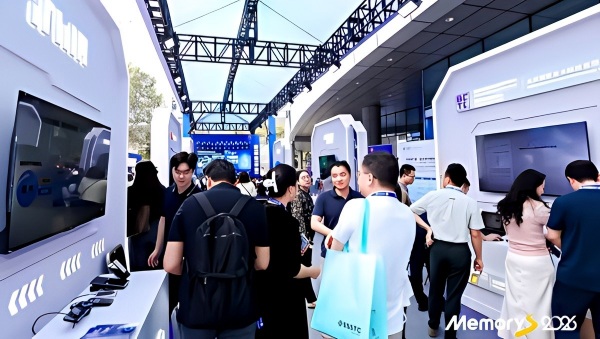
On March 27, CFMS | MemoryS 2026, themed “iTAP IMMERSING·PIONEERING THE FUTURE,” was held in Shenzhen. The Intelligent Terminal Microelectronics Association (ITMA), together with key ecosystem partners including Huawei, CEC Huada, Emperor Technology, Tsingteng Microsystem, and BCTC, jointly showcased their innovations at the event.
The lineup of exhibitors reflects a full-chain ecosystem spanning chips, terminal applications, and testing & certification, presenting a comprehensive view of the iTAP (Intelligent Touchless Awareness Protocol) ecosystem. At the exhibition area, a representative from ITMA’s Marketing Working Group gave a media interview, providing an in-depth overview of iTAP’s commercialization progress, its value for users and industry, ecosystem expansion strategies, and future roadmap—offering a comprehensive interpretation of this next-generation near-field interaction standard.
First, the chip layer support.
As a leading domestic security chip provider and a core NFC chip supplier within the iTAP ecosystem, CEC Huada focuses on mobile security and IoT scenarios such as NFC, eSE, and eSIM, building a solid foundation for the era of intelligent connectivity. At this exhibition, CEC Huada showcased a range of security chip products based on the integrated “NFC + eSIM + Secure Element (SE)” architecture, comprehensively covering core application scenarios of smart mobile terminals.
Tsingteng Microsystem, a core initiator of the iTAP protocol and a key contributor to chip support, has been deeply involved in chip technologies and compatibility validation. Its THN31 series chips have already been deployed in mainstream devices such as smartphones and wearables, supporting features including operation when powered off, intelligent card selection, fast access with the screen off, and high-level encryption—serving as critical hardware carriers of iTAP’s core capabilities.
Next is the terminal application layer.
Huawei, as a core initiator of iTAP, plays a key role in standard development, commercial deployment, scenario validation, and ecosystem promotion, serving as a central force in driving iTAP from standardization to large-scale adoption. Devices such as the Huawei Pura 80 and Watch GT5 are among the first to pass full compliance and interoperability testing for the iTAP access layer. With future smartphones and wearables coming with iTAP as a standard feature, along with upgrades to existing devices, iTAP is expected to rapidly achieve a user base in the hundreds of millions.
Emperor Technology, specializing in smart cards and radio frequency identification , is advancing the implementation of iTAP in enterprise-grade terminals. At the exhibition, Emperor Technology showcased multiple iTAP-enabled secure terminal solutions for full-scenario applications, including standalone in-vehicle payment terminals and modular metro readers.
Third is the testing and certification segment.
BCTCis an authoritative testing institution in China’s financial industry, providing critical technical support for bank card interoperability, chip migration, and fintech innovation. As a member of ITMA, BCTC has been authorized as an iTAP-accredited testing laboratory and will provide authoritative testing and certification services for iTAP-related products, with a focus on promoting compliant deployment of the iTAP ecosystem in financial applications.
Multi-Scenario Deployment: iTAP Enabling a New Paradigm for Near-Field Interaction
At the exhibition, a representative from the ITMA Marketing Working Group told the media that iTAP has moved beyond the conceptual stage and has established mature, replicable use cases across four core domains: payments & finance, retail, transportation, and enterprise services. Its core competitiveness lies in delivering tangible efficiency gains and cost benefits to both consumers (C-end) and enterprises (B-end).
In the payments and financial sector, iTAP breaks through traditional interaction limitations, enabling secure transactions even without network connectivity or under low battery conditions, and even supporting tap-to-pay when the device is powered off. In retail scenarios, it integrates the entire process—including payment, verification, and loyalty—into a single near-field interaction, significantly simplifying both store operations and user journeys. In high-frequency transportation scenarios, iTAP enables seamless access across buses, metros, and urban rail systems, with “intelligent card selection” making gate passage faster and smoother. In enterprise services, iTAP enables end-to-end automated reconciliation, effectively addressing challenges such as fragmented data across multiple systems and cumbersome manual verification processes.
For end users, iTAP delivers a “three-no, one-fast” experience—no unlocking, no scanning, no app searching, and faster access—improving transaction speed by 50% while supporting normal operation even when the device is powered off or offline, eliminating the complexity of traditional near-field interactions. For enterprise customers, iTAP establishes a unified standard for smart terminal ecosystems, significantly reducing inefficient customization efforts while ensuring consistent functionality and user experience across devices. According to the representative, adopting iTAP can reduce operational manpower by approximately 30%, lower equipment investment, improve operational efficiency, and enable end-to-end data connectivity to support refined operations and digital management.
Regarding commercialization and market promotion, the representative noted that iTAP’s core target groups include terminal manufacturers, industry enterprises, developers, and ecosystem partners, with tailored, tiered strategies for each segment.
For industry enterprises, the focus is on building benchmark use cases to enable rapid replication across sectors; for developers, open SDKs and toolchains are provided to lower development barriers and encourage innovative applications; for ecosystem partners, a unified certification system is being established to ensure full-chain interoperability across chips, terminals, and reader devices, delivering consistent cross-brand and cross-scenario user experiences.
In response to the technological transformation driven by AI, iTAP aims to become a unified gateway connecting the physical and digital worlds. The representative acknowledged that achieving this vision requires overcoming challenges across three dimensions: technology, ecosystem, and standards. On the technology side, deep integration with AI is needed to enhance intelligent sensing, scenario recognition, and security capabilities; on the ecosystem side, continuous expansion of terminal and scenario coverage is essential to enrich application ecosystems and increase user adoption; on the standards side, further refinement of industry standards and certification systems is required, along with accelerated internationalization to bring China’s homegrown near-field standards to the global stage.
Looking ahead to the next one to two years, the representative stated that ITMA will continue to improve the iTAP standards certification and testing system, strengthening the foundation for industry compliance; aim to achieve deployment across 50 million terminals to establish a large-scale user base; expand ecosystem partnerships to deepen collaboration across chips, terminals, and application scenarios; further advance the integration of AI and iTAP to unlock new innovative use cases; and steadily promote the internationalization of the standard.
As the ecosystem continues to evolve, device adoption expands, and AI capabilities deepen, iTAP is poised to emerge as a new paradigm for near-field interaction in the AI era—accessible to everyone and enabling connectivity across all devices—driving the industry to new heights.